
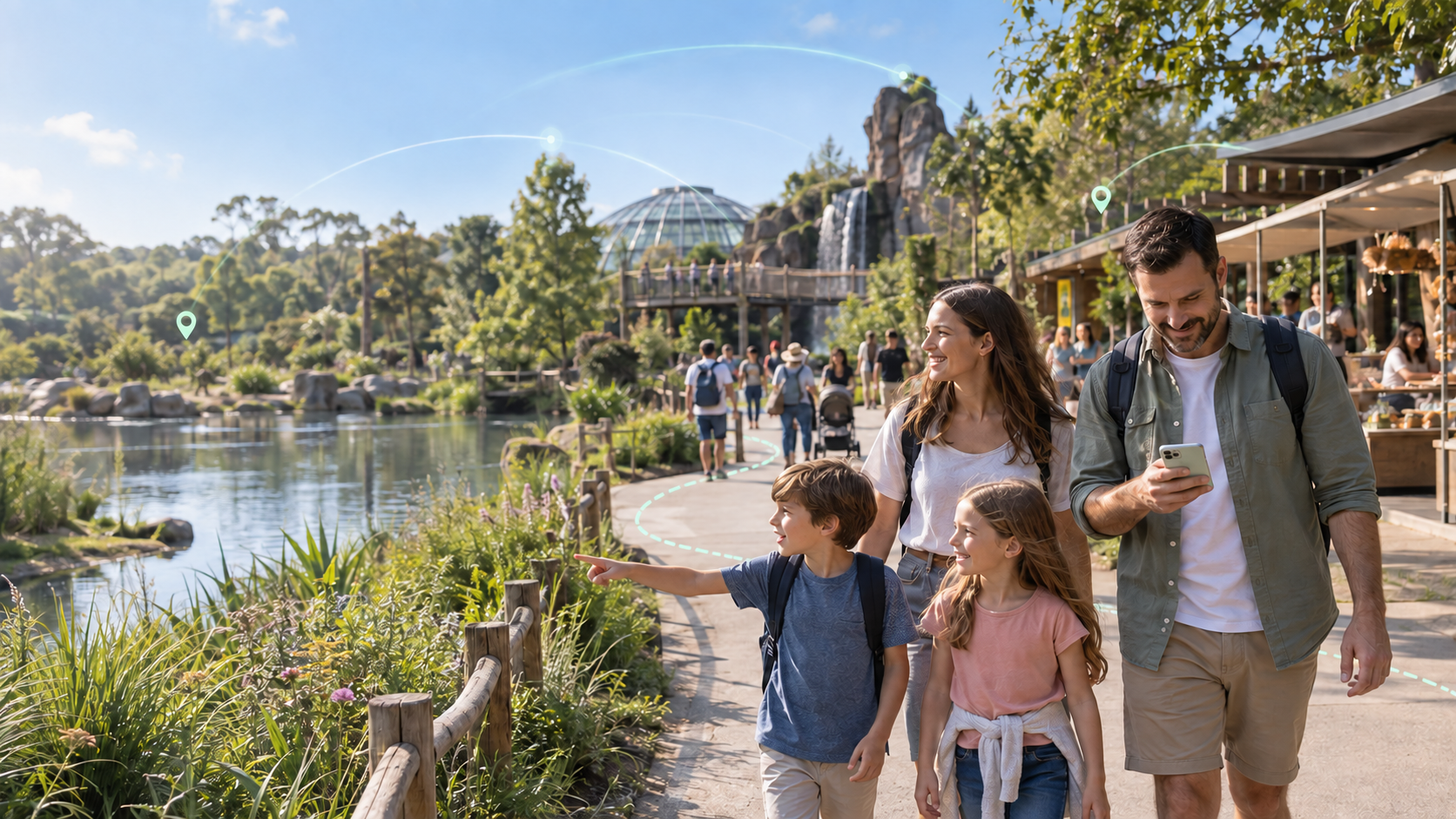
Key takeaways
- A guest experience app extends engagement beyond the website, from arrival to post-visit.
- Apps create a direct, permission-based channel to build lasting visitor relationships.
- They guide visitor decisions, offer real-time updates, and enhance on-site spend.
- An app supports storytelling, accessibility, and provides valuable operational insights.
- A modern platform approach makes app implementation achievable for attractions.
While a website helps visitors discover, plan, and book their trip, a guest experience app takes over upon arrival. It supports their day as it unfolds and fosters a direct relationship that can endure long after they leave the premises.
Why guest experience apps are now essential
For many years, visitor attractions often viewed a customer app as an optional extra, typically considered after prioritising the website, ticketing platform, and other operational necessities. However, this perspective is increasingly difficult to maintain.
For a wide range of venues including zoos, aquariums, wildlife parks, museums, heritage attractions, and theme parks, a guest experience app is now becoming a core component of visitor infrastructure. This shift is not merely about adopting more technology, but recognising that websites, ticketing platforms, and apps serve distinct functions. Relying solely on a website can leave significant gaps in the visitor journey.
A good website facilitates discovery, helps visitors understand offerings, plan their day, check practical details, and purchase tickets. However, once visitors arrive, their needs change. They require real-time information such as today's schedule, wayfinding, travel times between points, must-see exhibits, dining options, and availability of bookable experiences.
A conventional website was not designed to manage this dynamic, live interaction; a guest experience app is. Crucially, an app can continue to deliver value post-visit, transforming a one-time visitor into a repeat guest, member, supporter, and advocate.
Harnessing the power of ongoing relationships
Discussions about apps can often become overly focused on the technology itself. The more pertinent question is not whether an attraction needs an app, but rather the value that can be generated by sustaining a direct relationship with visitors before, during, and after their day out.
Attractions invest heavily in capturing attention through various channels, including search engines, social media, content marketing, partnerships, public relations, promotions, and advertising. When a visitor eventually purchases a ticket and enters the attraction, this moment should signify the commencement of a customer relationship, not the conclusion of the acquisition journey.
A well-designed app provides attractions with a permission-based channel, enabling them to help visitors:
- Experience more of what the attraction offers.
- Spend more appropriately based on their interests.
- Return sooner for another visit.
- Develop a deeper connection with the organisation.
The visitor journey thus becomes a connected sequence: discover, book, visit, engage, spend, return, join, and recommend.
Guiding visitor decisions for a better experience
A visit to a large attraction such as a zoo, safari park, aquarium, museum, or heritage site spans several hours. Throughout this time, visitors make numerous small decisions that collectively dictate whether their experience feels seamless or stressful. They ponder their next destination, whether a particular talk is worth waiting for, when to break for food, and if there is enough time to see one more exhibit before departing.
For families managing children, pushchairs, energy levels, and diverse interests, each moment of uncertainty adds pressure. Clear digital support can alleviate this burden by providing:
- An interactive map with clear walking times.
- Searchable information on facilities, exhibits, and experiences.
- Live schedules detailing 'what's on' and 'when'.
- Personal reminders to help visitors avoid missing key moments.
The app should complement, not compete with, the physical experience, and should not demand constant attention. At its best, it serves as a subtle guide in the background, assisting visitors with navigation, helping them understand their surroundings, and ensuring they feel they have maximised their visit.
This is especially vital for large, complex, or multi-zone sites. Visitors who become disoriented, repeatedly retrace their steps, or miss important areas may leave feeling that their day offered less value than it actually did. Enhanced wayfinding not only improves navigation but also significantly boosts the visitor's overall perception of the experience.
Real-time communication for dynamic attractions
Visitor attractions are inherently dynamic environments. Weather conditions can change, animal welfare decisions may be made, staffing levels fluctuate, crowd numbers vary, and operational issues can emerge with little notice. Yet, many organisations still depend on communication methods designed for a more static experience.
An app empowers teams to respond to the day as it unfolds. It can be used to:
- Instantly update schedules.
- Forewarn visitors before they make a journey across the site to an unavailable experience.
- Suggest indoor activities when the weather deteriorates.
- Guide guests to quieter areas if a popular zone becomes crowded.
- Remind visitors about talks or feeds commencing nearby.
The practical benefits are clear. A message announcing that the shark feed begins in fifteen minutes, or that the tiger talk starts at 2:30 PM a short walk from the visitor's current location, is far more valuable than information buried on a web page. The same channel can explain disruptions, acknowledge inconvenience, and offer sensible alternatives before frustration sets in.
No attraction can prevent every problem, but guest satisfaction often hinges on whether people feel informed and cared for when changes occur. In a market where online reviews and social sharing significantly influence future visits, timely communication holds considerable reputational and commercial value.
Driving revenue growth during the visit
While increasing admissions will always be important, it is not the sole path to growth. For many attractions, enhancing the value derived from existing visitors can be equally, if not more, significant. Revenue streams such as food and drink, retail purchases, tours, animal encounters, unique experiences, special events, memberships, donations, gift vouchers, and future visits all contribute to the economic health of the attraction.
Often, the challenge is not a lack of demand, but rather visitors failing to discover the right opportunity at the optimal moment. An app can address this by:
- Displaying nearby food and drink options.
- Showing real-time availability for tours, encounters, or other experiences.
- Highlighting events that align with the visitor's schedule.
- Presenting relevant retail or membership prompts at a natural point in their journey.
Context and timing are paramount. A visitor standing before a giraffe might be far more receptive to an animal encounter or a conservation appeal than someone receiving a generic email weeks later. A family thoroughly enjoying their day may be more open to purchasing a membership before they leave, rather than after returning home.
Extending engagement from a day trip to a year-round relationship
The most significant long-term opportunity may begin once the visitor departs. Many attractions rely on annual passes, memberships, return schemes, and repeat visitation. However, merely issuing a pass does not automatically foster an engaged relationship.
An app can provide the digital infrastructure to support this ongoing relationship. Tickets and passes can be stored on the visitor's phone. Members can be regularly informed about new arrivals, seasonal events, exhibitions, and exclusive experiences. Incentives for return visits can be presented at opportune moments, and renewal messages can be made relevant rather than feeling routine.
For multi-site organisations, a single app can offer visitors a familiar point of access across the entire estate, while still allowing each location to maintain its unique maps, content, events, and character. Central teams gain consistency and oversight, while local teams retain the flexibility to reflect site-specific happenings.
The attraction remains present long after the visitor has exited the car park. The objective therefore shifts from merely maximising the value of a single visit to increasing the lifetime value of the visitor relationship.
The value of an owned audience
Attractions can cultivate substantial audiences on social media platforms, yet these audiences ultimately reside within environments controlled by others. Algorithms change, organic reach diminishes, and advertising costs escalate. Reaching individuals who already know and appreciate the attraction can still necessitate additional media spend.
An opted-in app audience represents a different scenario. It establishes a direct channel to individuals who have demonstrated genuine intent by visiting and engaging. When appropriately integrated with consented email data, ticketing, membership, and customer relationship management systems, it can become a valuable first-party audience asset.
This does not negate the importance of social media or email. Instead, it clarifies the role of each channel and reduces reliance on any single one. The website attracts and converts, social media builds reach and interest, and email supports planned communications. The app, however, adds immediacy, location-based relevance, context, and continuity throughout the visitor journey.
Relevance over volume in communication
A family visiting today has different requirements from a member at home. A first-time visitor differs from someone returning for the fifth time. A visitor interested in conservation may respond to different content than someone planning a family day out.
An app enables communication to become more relevant without being intrusive. Personalisation can start simply, with suggestions for visitors who have limited time, indoor activities during inclement weather, accessibility information, reminders based on selected interests, or messages informing members of new developments since their last visit.
The objective is not to send more messages, but to send fewer, higher-quality messages, tailored by context and permission. The principle of delivering the right message to the right customer at the right moment is far more valuable than broadcasting the same content to everyone.
Enhancing accessibility through information and confidence
True accessibility encompasses more than just physical infrastructure. It also depends on visitors' ability to understand the experience, foresee potential barriers, and make informed decisions without undue anxiety.
An app can discreetly and clearly provide crucial accessibility information, including:
- Accessible routes, gradients, and walking distances.
- Locations of facilities and accessible toilets.
- Designated quiet spaces and resting areas.
- Practical information regarding individual exhibits and experiences.
This benefits a diverse range of individuals, including families, older visitors, those with mobility needs, and visitors who appreciate greater predictability. Better information empowers more people to participate confidently, thereby reinforcing the attraction's broader commitment to inclusion.
Storytelling that travels with the visitor
For zoos, aquariums, wildlife parks, museums, and heritage attractions, education and storytelling are fundamental to their mission. However, on-site signage often competes for attention with children, conversations, queues, and the practical demands of the day. While talks are valuable, they can easily be missed.
A guest experience app allows stories to be delivered precisely when visitors are most engaged. Information about species, conservation projects, collection histories, audio guides, video content, quizzes, and insights from keepers or curators can be discovered contextually, directly at an exhibit, or along a designated trail.
This approach extends, rather than replaces, on-site interpretation. It also makes engagement more measurable. Attractions can gain insights into popular subjects, content that visitors revisit, and areas where important stories might be overlooked. This evidence can then inform improvements in education, interpretation, programming, and future funding discussions.
Insight for better operational decisions
Most attractions already gather data, but much of it remains disconnected from the actual visitor experience. Ticketing systems record purchases, transaction systems track what was bought, and web analytics show pre-visit browsing behaviour. However, these systems do not necessarily explain how visitors navigate the site, where they spend their time, what captures their attention, or which messages prompted specific actions.
A connected guest experience platform can bridge this gap. Data on content engagement, searches, map usage, campaign responses, visitor flows, and dwell patterns can begin to reveal how the experience is truly utilised.
The aim is not to collect data indiscriminately, but to facilitate better decision-making. Insights can help teams test assumptions, understand the effectiveness of changes, and inform key areas such as:
- Programming and staffing allocations.
- Food and drink provision.
- Queue management and site layout optimisations.
- Interpretation strategies and marketing campaigns.
- Future investment decisions.
Overcoming the 'another app' objection
The most frequent objection to an app is that visitors do not want to download another one. There is truth in this; few people are keen to install an app that offers no clear or immediate benefit.
The solution is not to abandon the channel, but to make its value undeniable. Immediate reasons for visitors to use the app could include:
- Digital ticket or pass storage.
- Today's schedule and an interactive map.
- Personal reminders and accessibility information.
- Exclusive content and useful offers.
The attraction then needs to provide compelling reasons for the relationship to continue. New events, seasonal content, member benefits, conservation stories, return incentives, and fresh experiences can ensure the app remains relevant beyond the initial visit.
Therefore, the pertinent question is not whether visitors will abstractly download an app. Rather, it is whether the attraction can create sufficient value that visitors actively choose to download, use, and retain it. This is fundamentally a service design challenge, not merely a technological one.
Leveraging platforms, not becoming a tech company
Historically, developing an app often entailed a substantial bespoke project, involving extensive specification, design, development, hosting, security, releases, updates, and ongoing maintenance. For many independent and medium-sized attractions, the associated costs and internal burden were difficult to justify. However, modern Software as a Service (SaaS) platforms change this equation.
With a platform approach, the attraction can control its brand, content, campaigns, and visitor experience, while the platform provider manages the underlying technology, maintenance, compatibility, and continuous improvements.
This is particularly crucial in a sector where internal capacity often remains constrained. The n-gage.io 2026 benchmark research revealed that only three out of twenty-nine participating attractions had a fully integrated digital visitor platform, with internal skills and capacity being the most frequently cited digital barrier.
A platform approach also supports phased integration with existing ticketing, booking, membership, customer relationship, and other operational systems. An attraction does not need to connect everything from day one. It can begin with areas that offer the clearest visitor and commercial value, then expand as priorities evolve and confidence grows.
Website and app: complementary tools
The argument for an app is not an argument against investing in a website. Attractions require both, as each serves a distinct phase of the visitor relationship.
- The website supports discovery, research, planning, and booking.
- The app supports arrival, on-site experience, engagement, spending, return visits, membership, and advocacy.
One helps acquire and convert the visitor; the other helps the attraction serve and cultivate that relationship. Ticketing, customer relationship systems, membership platforms, and operational tools also play vital roles. The objective is not to replace the existing technology estate with another isolated system, but to create a connected engagement layer that unifies the visitor journey and makes useful data accessible across the wider organisation.
From visitor numbers to lifetime value
Admissions will always be a defining metric for visitor attractions; the number of people entering through the gate matters. However, digital engagement presents an opportunity to ask a more sophisticated question: what is the lifetime value of each visitor relationship?
Consider two attractions, each welcoming 300,000 visitors annually, with identical admission figures. One maintains very little direct relationship with these customers after they depart. The other, however, converts a significant proportion into an owned digital audience. These visitors return more frequently, attend events, purchase experiences, spend in retail and food outlets, become members, make donations, buy gifts, and recommend the attraction to others.
While the admission figures may be identical, the economic outcomes are vastly different. This is why the conversation around customer apps has evolved. It is no longer simply about adding a digital feature to the visitor experience; it is about whether an attraction can afford not to build a direct, useful, and measurable relationship with the people it has worked so diligently to acquire.
A website brings people to the attraction. A great guest experience app helps them enjoy more during their visit and keeps the attraction connected with them long after they leave.
Want this applied to your attraction?
We are happy to talk through your own plans, even at an early stage.
Related reading
When the weather changes, your guest experience needs to change too
Rain can change a holiday park’s plans in minutes. Discover how a connected guest journey can help your team communicate clearly, promote alternatives and protect the quality of the stay.
Read articleBefore guests arrive: the decisions that shape a better holiday
The guest experience begins before check-in. Discover how clear pre-arrival information and a connected park app can help guests prepare, discover activities and start their break with confidence.
Read article